

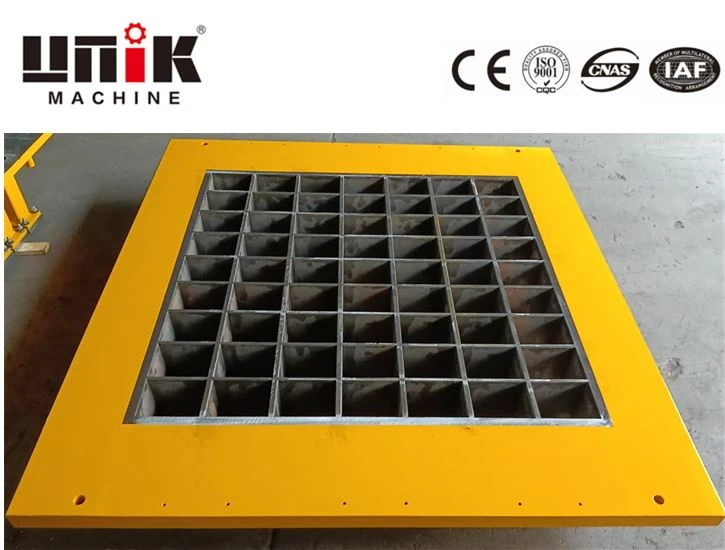


Concrete Hollow Block Mould For Sale
2.Hardness for shoes:HRC59-62
3.Carburized layer thickness:1.3-1.5mm
4.Unilateral clearance between presser foot and mold cavity: 0.2 mm ≤ Unilateral clearance ≤ 0.4mm
5.Flatness of the whole board: ≤ 0.5mm
6.Deviation in length and width dimensions of a single cavity model: -0.3 to+0.3mm
7.The dimensional deviation of the height (filling depth) of the lower model cavity is ± 0.5mm
Send Inquiry
Product Details ofConcrete Hollow Block Mould For Sale
Concrete Hollow Block Mould for Sale: The Professional Buyer's Guide
Precast concrete hollow blocks are fundamental to modern construction, offering structural efficiency, thermal insulation, and material economy. For producers, the mould is the single most critical determinant of block quality and production cost. Choosing the right hollow block mould directly impacts dimensional consistency, output volume, and long-term profitability.
Since 2010, Fujian Unik Mould Technology Co., Ltd. has been a global leader in precision concrete mould manufacturing. Located in Quanzhou, China, UNIK combines engineering rigor with deep industry expertise, exporting high-performance moulds to 28 countries. This guide provides a comprehensive framework for sourcing, selecting, and utilizing a concrete hollow block mould for your production needs.

Selection Guide: How to Choose the Right Hollow Block Mould
Selecting a hollow block mould requires a systematic evaluation of your production requirements, machine compatibility, and material specifications. Follow this step-by-step framework:
Step 1: Define Block Dimensions and Core Configuration
This is the primary specification parameter.
Metric Markets: Predominantly use 400×200×200mm blocks with two or three cores.
Imperial Markets: Typically specify 8×8×16 inch blocks.
Cavity Count: The number of cavities per mould depends on your block machine's capacity. Common configurations include two, three, and four cavities per mould.
Professional Recommendation: While increasing cavity count improves output per cycle, it simultaneously increases mould complexity and reduces structural rigidity. Machines with limited vibration power may produce inconsistent block quality with excessively high cavity counts.
Step 2: Select Steel Grade and Heat Treatment by Production Volume
The steel grade and heat treatment determine mould lifespan and cost per block.
| Annual Production Volume | Recommended Steel | Heat Treatment | Expected Service Life |
|---|---|---|---|
| Below 200,000 units | 40Cr | Standard quenching | 30,000 – 50,000 cycles |
| 200,000 – 500,000 units | 42CrMo | Carburizing | 80,000 – 100,000 cycles |
| Above 500,000 units | Tool steel | Carburizing + Nitriding (core pins) | 100,000 – 150,000 cycles |
Professional Recommendation: For high-volume operations, the higher initial investment in premium materials and heat treatment results in lower mould cost per block over the equipment's service life.
Step 3: Verify Machine Compatibility
Block machine manufacturers-including HESS, MASA, ZENITH, BESSER, TIGER, Qunfeng, Hengxing, and Quangong-employ distinct frame dimensions, bolt hole patterns, and locating pin configurations.
Professional Recommendation: Providing a photograph of the machine nameplate at the time of mould ordering is the most reliable method for ensuring proper fit. For older or non-standard machines, supplying an existing mould or detailed dimensional drawings enables accurate reverse engineering.
Step 4: Assess Concrete Mix Abrasiveness
The aggregates within concrete exert continuous abrasive wear on mould surfaces. Abrasiveness levels are determined by:
Aggregate hardness: River sand < Crushed stone < Quartz sand
Aggregate morphology: Rounded particles cause less wear than angular particles
Presence of recycled materials
Professional Recommendation: For highly abrasive concrete mixes, procurement specifications should include: cavity surface hardness exceeding HRC60, nitriding treatment for core pins with a diffusion layer of at least 0.03mm, and a scheduled wear inspection protocol for pin replacement.
Frequently Asked Questions (FAQs)
Q1: What causes uneven wall thickness in hollow block production?
The most probable cause is core pin displacement. Inspection should focus on pin plate deformation, wear at pin roots, and loosening of locking bolts. Improper mould mounting can also transmit machine vibration directly to the core pin structure.
UNIK Technical Guidance: After every 5,000 to 10,000 production cycles, measure wall thickness at multiple points using calibrated calipers. If deviation exceeds 0.5mm, suspend production and conduct a complete alignment inspection.
Q2: Why are the edges of block cavities chipping during demolding?
Cavity edge damage typically originates from either rough core pin surfaces or insufficient draft angle.
UNIK Technical Guidance: Core pin surfaces should be polished to Ra 0.8µm or better. Draft angle should not be less than 1 degree per side. UNIK's standard of 1.5 degrees ensures reliable demolding without compromising wall thickness.
Q3: What is the typical service life of a hollow block mould?
Under standard production conditions-conventional concrete mixes, correct operational procedures, and regular maintenance-UNIK's 42CrMo carburized moulds achieve 80,000 to 100,000 cycles. In double-shift operations producing 4,000 blocks daily, this translates to 9-12 months of service.
UNIK Technical Guidance: Monitor cumulative cycle counts rather than relying on subjective assessments of wear. UNIK offers RFID tagging for moulds, which automatically records usage data and generates alerts when approaching expected service limits.
Q4: Can moulds be refurbished? What is the service life after refurbishment?
Yes. Worn moulds can be refurbished through re-machining, re-heat treatment, and replacement of worn components (wear sleeves, core pins).
UNIK Technical Guidance: Refurbished moulds achieve 80-90% of new mould service life at 60-70% of new mould cost.
Q5: What documentation is needed to import moulds to my country?
The following documentation is typically required:
Commercial invoice and packing list
Bill of lading
Certificate of origin ("Made in China")
Material certificate (confirming steel grade and chemical composition)
Heat treatment report (confirming specified hardness levels)
UNIK Technical Guidance: UNIK has over 15 years of export experience and is familiar with import requirements for most countries.


Certifications & Quality Assurance
Quality is non-negotiable in precision tooling. UNIK's commitment to excellence is validated by its robust quality management system:
ISO 9001:2015 Certified: Our entire manufacturing process, from design to delivery, follows internationally recognized quality management standards, ensuring consistency and traceability.
CE & SGS Certified: Our moulds meet the essential safety and environmental requirements for the European market and are verified for performance by leading inspection bodies.
Material Certification: All steel used is sourced from certified mills and is accompanied by material test reports, guaranteeing the specified composition and properties.
Hot Tags: concrete hollow block mould for sale, China concrete hollow block mould for sale manufacturers, suppliers, factory, Cement Block Mould, Concrete Block Mould, Concrete Hollow Block Mould, Mould for Concrete Blocks, Pavement Block Moulds, Steel Block Mould for Block Making Machine
Previous
No InformationNext
Hexagon Paver MouldSend Inquiry
