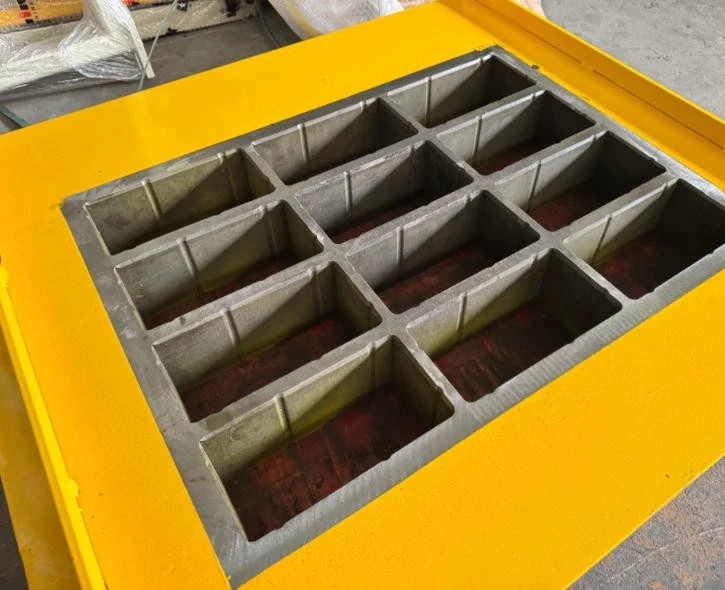
Mould Maintenance Guide: Sharpening and Demagnetizing Curbstone Mould Edges
In the concrete products manufacturing industry, the edge condition of curbstone moulds directly determines product quality and production efficiency. Many production interruptions and rising scrap rates can be traced back to neglecting the two most critical aspects of mould maintenance: edge sharpening and demagnetization. As a professional mould manufacturer, Fujian Unik mould Technology Co., Ltd. shares this practical guide on curbstone mould edge maintenance based on industry experience.
Why Are Edge Sharpening and Demagnetization Crucial?
During long-term use, the cutting edges of curbstone moulds gradually wear and become blunt due to continuous physical friction and impact. A blunt edge not only increases forming resistance but also causes defects such as burrs, unevenness, and even chipping on the edges of concrete products, severely affecting product quality. Therefore, regular edge sharpening is a necessary measure to restore mould performance.
However, the sharpening process itself brings a "side effect" – magnetism. The friction between the grinding wheel and the mould steel generates heat and a magnetic field during sharpening, leaving residual magnetism on the edge surface. This seemingly minor magnetism can cause major problems in production: magnetized edges act like magnets, attracting fine ferrous particles or dry mix from the concrete slurry, easily causing poor material flow and blockages, forcing frequent production interruptions and time-consuming cleaning.
Correct Edge Sharpening and Demagnetization Procedures
1. Edge Sharpening Guidelines
The goal of sharpening is to "sharpen the tool," not to excessively consume the mould. Precautions include:
Timing Judgment: When product edge quality declines or forming resistance increases noticeably, sharpening is required.
Precision Control: Sharpening should be performed by trained personnel using appropriate grinding machines and wheels. The feed rate per pass should not be excessive to avoid localized softening of the edge due to overheating, which would shorten mould life. Industry technical data suggests that the single grinding amount should not exceed 0.013mm, and adequate coolant must be used.
Moderation Principle: The edge has a limited grinding allowance. Once the wear limit is reached, the mould must be scrapped. Excessive grinding directly leads to mould failure.
2. Critical Step: Demagnetization
This is an absolutely essential step after sharpening. After sharpening and thorough cleaning, the edge area must be immediately and completely demagnetized using a professional demagnetizer. The goal is to ensure complete demagnetization of the edge surface, which is as important as the sharpening itself.
Comprehensive Mould Maintenance System
Beyond edge maintenance, a sound mould care system should also include regular inspection and replacement of wear parts such as springs, punches, and punch sleeves, as well as checking for air leaks in the pneumatic ejection system.
Important note when replacing springs: The replacement spring's specifications must be confirmed through three parameters: color, outer diameter, and length. All three must match exactly before replacement.
| Maintenance Item | Key Operation | Primary Purpose |
|---|---|---|
| Edge Sharpening | Precision grinding of worn edges at regular intervals. | Restore edge sharpness and ensure product edge quality. |
| Demagnetization | Immediate demagnetization with a demagnetizer after sharpening. | Eliminate edge magnetism to prevent material blockage and ensure smooth production. |
| Replacing Punches/Sleeves | Replace with identical specification parts. | Repair broken, bent, or damaged components. |
| Replacing Springs | Confirm color, outer diameter, and length all match before replacement. | Restore elastic function and prevent failures caused by spring fatigue. |
Establish Maintenance Records
It is highly recommended that manufacturers create detailed maintenance files for each mould set, recording the dates and specific actions of every sharpening, demagnetization, and parts replacement. This not only helps track mould service life but also generates scientific production management data, allowing for proactive spare parts planning and avoiding sudden production halts due to unexpected failures.
In conclusion, "demagnetize every time you sharpen" is a core golden rule in curbstone mould maintenance. Correctly executing both operations, combined with a comprehensive upkeep system, effectively extends mould service life and ensures efficient, stable production line operations.