




Paver Block Mould Buy Online
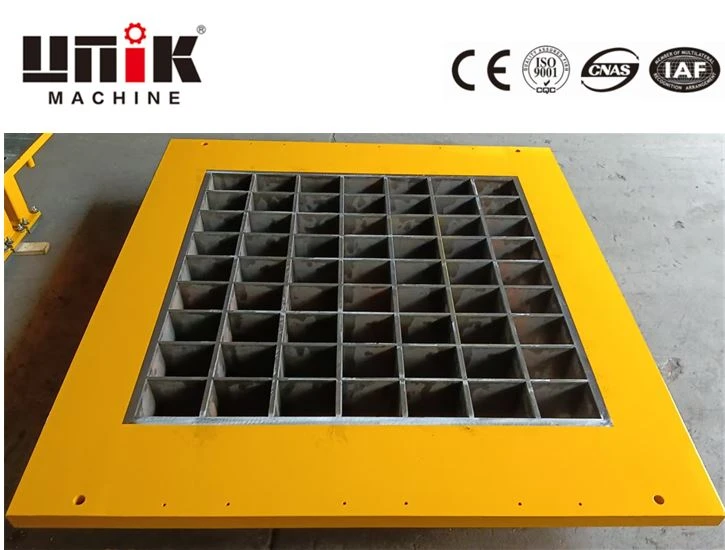
2.Hardness for shoes:HRC59-62
3.Carburized layer thickness:1.3-1.5mm
4.Unilateral clearance between presser foot and mold cavity: 0.2 mm ≤ Unilateral clearance ≤ 0.4mm
5.Flatness of the whole board: ≤ 0.5mm
6.Deviation in length and width dimensions of a single cavity model: -0.3 to+0.3mm
7.The dimensional deviation of the height (filling depth) of the lower model cavity is ± 0.5mm
Send Inquiry
Product Details ofPaver Block Mould Buy Online
Paver Block Mould Buy Online
Material & Performance Specifications
The longevity and cost-per-part of a paver block mould are determined primarily by two factors: steel grade selection and heat treatment execution. UNIK addresses both through a systematic approach:
Steel Selection by Application
42CrMo – Our baseline material for standard concrete mixes, offering an optimal balance of wear resistance and toughness for most paving applications.
Cr12MoV – Upgraded tool steel specified for highly abrasive formulations (e.g., colored aggregates, recycled concrete with high silica content), delivering extended service life in demanding production environments.
Heat Treatment & Hardness Profile
Rather than applying a uniform hardness across the entire mould, UNIK employs a carburizing process that creates a functional gradient:
Case (surface layer): Hardened to HRC 58–62, providing the wear resistance needed to withstand abrasive concrete flow over hundreds of thousands of cycles.
Core (subsurface): Maintained at HRC 35–40, preserving the toughness and ductility required to absorb impact loads without cracking.
This gradient design prevents the brittleness that often causes premature failure in uniformly hardened moulds.

Precision-Fit Engineering – No "One-Size-Fits-All"
UNIK does not supply generic moulds with approximate dimensions. Every paver block mould is engineered for a specific machine model based on the brand, model number, and base-plate mounting drawings provided by the customer. Our interface database covers major global press brands including Hess, Masa, Tiger, Zenith, and Quadra, ensuring that each mould arrives ready for immediate installation without on-site modifications.
Solid-Billet CNC Construction – The Foundation of Reliability
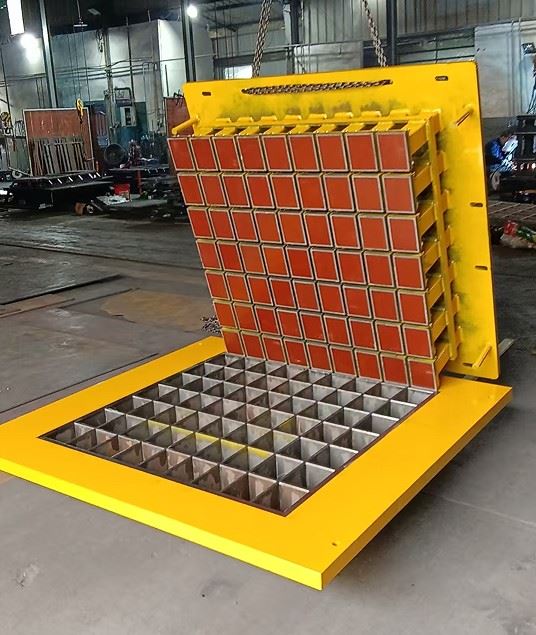
Instead of the welded assemblies common among lower-tier suppliers, UNIK moulds are machined from a single solid block of forged tool steel. This eliminates weld-induced warping and stress concentration, delivering three measurable benefits:
Surface finish of Ra 1.6 or better on every cavity, combined with optimized draft angles, enables fast, clean demoulding without sticking or surface drag marks.
Critical dimensional tolerances are held to ±0.1mm across all locating and forming surfaces, guaranteeing consistent paver dimensions from the first cycle to the last.
Internal corner radii of 3–5mm are precision-ground into each cavity to disperse cyclic loads, effectively preventing fatigue cracks and extending the mould's service life well beyond industry averages.
Frequently Asked Questions
Q1: How long does it take to receive a paver block mould after placing an order?
For custom-engineered moulds, the production timeline is 25–35 days from final design sign-off. This covers 3D modeling, raw material procurement, heat treatment, CNC machining, and multi-stage quality checks. If you require a standard (non-custom) design on an urgent basis, we can compress the schedule to 15–20 days.
Q2: What information do you need to guarantee a perfect fit on my block machine?
Simply share your machine's brand and model number, along with a dimensional drawing of the base plate (including clamping points and bolt patterns). Our engineering team will generate a 1:1 CAD overlay to validate every mounting interface before we begin manufacturing – no guesswork, no field modifications.
Q3: Which steel grades do you use, and how do they affect performance?
We offer two primary grades: 45# medium-carbon steel – pre-hardened, cost-effective, and ideal for standard production runs; and Cr12MoV tool steel – high-carbon, high-chromium, chosen for extreme abrasion resistance and extended campaign life. Every batch receives controlled heat treatment to hit the specified surface hardness (HRC 58–62), balancing wear resistance with core toughness.
Q4: What kind of after-sales support can I expect as an overseas customer?
Every mould ships with a detailed digital care manual covering installation, daily cleaning, lubrication, and long-term storage. For troubleshooting, we offer live video assistance. On-site commissioning support is available for large-volume orders. All moulds are backed by a 12-month warranty against material defects and workmanship errors.
Q5: How are moulds protected against rust during transit and storage?
Each mould is wrapped in VCI (Vapor Corrosion Inhibitor) paper, sealed in shrink film, and packed in export-grade plywood crates that meet ISPM15 fumigation-free standards. This multi-layer protection keeps the cavity surfaces corrosion-free for up to 12 months when stored in a dry, covered environment.
Certifications & Quality Assurance
UNIK's concrete block moulds carry CE marking and SGS certification, demonstrating compliance with European safety, health, and environmental requirements, as well as verified performance against internationally recognized quality benchmarks.
Our quality assurance system is built on four interlocking layers of control, not a single inspection at the end of the line:
| Control Layer | What We Verify | How It's Done |
|---|---|---|
| Incoming Material | Steel grade, chemical composition, and hardness range against purchase order | Mill Test Certificates (MTC) provided with every batch, reviewed before any cutting begins |
| In-Process Machining | Cavity dimensions, surface finish, and alignment at each stage | Continuous monitoring on CNC equipment; first-article inspection using CMM |
| Post-Heat Treatment | Achieved surface hardness (HRC 58–62) and case depth (1.3–1.5mm) | Dedicated hardness tester on every mould, not random sampling |
| Pre-Delivery Final | Full dimensional compliance, visual finish, and accessory completeness | Multi-point CMM scan + visual check; inspection report accompanies each shipment |
Beyond these procedures, UNIK's manufacturing process integrates three proven technologies:
German-sourced heat treatment furnaces with precise atmosphere and temperature control for consistent metallurgical results.
Multi-axis CNC machining centers capable of holding ±0.1mm tolerances across complex cavity geometries.
ISO-compliant quality management documentation, ensuring every step is recorded, traceable, and auditable.
All inspection records – including hardness charts, CMM reports, and material certificates – are archived and available to customers upon request, providing full transparency from steel mill to shipping dock.
Customer Case Studies

Case 1: Southeast Asian Paver Manufacturer
Challenge: Locally fabricated moulds caused 12% reject rates due to poor core pin alignment .
Solution: UNIK supplied CNC-machined 4-cavity moulds with ±0.05mm core alignment and optimized 1.5° draft angle .
Result: Reject rate dropped to 3% within two months; mould life exceeded 200,000 cycles

Case 2: Middle East Precast Company
Challenge: Client required double-layer paver (color top + structural base) with sharp edges and textured surface .
Solution: UNIK designed a stepped cavity with specialized venting pattern for controlled powder distribution .
Result: Consistent color layer thickness (3–4mm) achieved; client secured major landscape contract .

Case 3: African Infrastructure Project
Challenge: Contractor required 500,000 pavers monthly for road shoulder project .
Solution: UNIK supplied hard-chrome plated core pins and nitrided cavity surfaces .
Result: Moulds ran three shifts daily for 14 months, producing 700,000+ pavers before refurbishment .

Case 4: Cape Town Paver Factory
Challenge: Existing moulds limited production efficiency .
Solution: Switched to UNIK heavy-duty paver moulds .
Result: Production increased by 18% .
Our factory

Manufacturing

Delivery

workshop

Process
Industry Trends
The concrete paver mould industry is evolving rapidly, driven by changing customer expectations, sustainability mandates, and production efficiency targets. UNIK tracks and responds to four key shifts shaping the market today.
1. Interchangeable Cavity Systems
End users are moving away from single-purpose moulds toward modular designs that support multiple paver formats on a single base plate. For example, a single mould can now produce both solid pavers and hollow-core (drainage/grass) pavers simply by swapping core pin inserts.
UNIK's approach: We supply quick-change pin systems with standardized mounting interfaces, enabling format changes in under 15 minutes without removing the mould from the press. This reduces capital expenditure and storage space while increasing production flexibility for job-site variations.
2. The CNC Advantage Over Welded Construction
Welded moulds are rapidly disappearing from mature markets due to two inherent weaknesses: thermal distortion during welding and inconsistent cavity dimensions over time. Buyers now recognize that CNC-machined solid-billet moulds are not a premium upgrade but the minimum acceptable standard.
UNIK's position: Since 2022, we have operated a dedicated 5-axis CNC machining cell specifically for paver mould production. This enables us to hold ±0.05mm alignment between cavities and ±0.1mm overall dimensions – tolerances that welded construction simply cannot achieve.
3. Lightweight, High-Void Pavers
Architects and urban planners are specifying pavers with void ratios of 20–30% – double the traditional 10–15% – for three reasons:
Reduced concrete consumption per square meter (lower material cost and carbon footprint)
Lower shipping weight (reduced logistics expenses)
Enhanced stormwater infiltration (permeable pavement regulations)
These designs demand thinner core pins (down to 3mm wall thickness) and tighter positional tolerances to prevent core breakage and ensure uniform void geometry. UNIK's ±0.05mm alignment capability and hardened steel core pins are specifically engineered for these lightweight applications, reliably producing pavers with wall thicknesses as low as 25mm.
4. Cycle-Time Compression
Modern automatic block machines operate at 15–20 second cycle times – a 40% reduction from the 25–30 second standard of five years ago. At these speeds, moulds become the limiting factor if they cannot demould cleanly and consistently.
UNIK's response: We combine optimized venting channels (to release trapped air during compaction) with polished, nitrided cavity surfaces (to reduce adhesion and sticking). The result is demoulding times as low as 12 seconds for standard hollow pavers, giving our customers a productivity edge over competitors using conventional moulds.
Hot Tags: paver block mould buy online, China paver block mould buy online manufacturers, suppliers, factory, Brick Paver Mould, Cement Paver Mould, Grass Paver Mould, Interlocking Paver Mould, Paver Block Mould, paver moulds
Send Inquiry
