

Can a concrete slab mould be used for fiber - reinforced concrete slabs?
As a supplier of Concrete Slab Moulds, I often encounter inquiries from customers regarding the compatibility of our moulds with fiber - reinforced concrete slabs. In this blog, I will delve into this topic, exploring the technical aspects, advantages, and considerations when using concrete slab moulds for fiber - reinforced concrete.
Understanding Fiber - Reinforced Concrete
Fiber - reinforced concrete (FRC) is a composite material consisting of cement, aggregates, water, and discrete fibers. These fibers, which can be made of materials such as steel, glass, synthetic polymers, or natural fibers, are added to the concrete mix to enhance its mechanical properties. The addition of fibers improves the concrete's tensile strength, toughness, crack resistance, and durability.
The fibers in FRC act as a reinforcement mechanism, bridging cracks and distributing stresses more evenly throughout the concrete matrix. This results in a material that is less prone to cracking, especially under flexural or impact loads. FRC is commonly used in applications where high performance and durability are required, such as industrial floors, pavements, bridge decks, and precast concrete elements.
Compatibility of Concrete Slab Moulds with Fiber - Reinforced Concrete
The good news is that in most cases, standard concrete slab moulds can be used for fiber - reinforced concrete slabs. Our Slab Moulds For Sale are designed to be versatile and can accommodate different types of concrete mixes, including those with fibers.

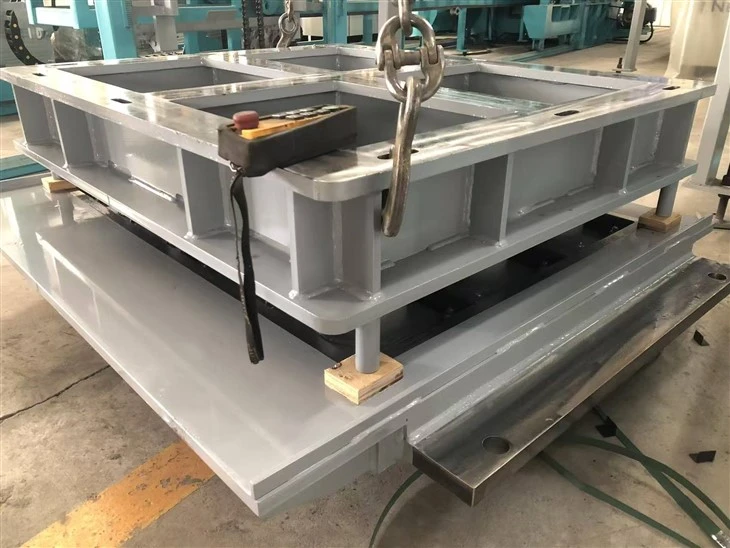
The key factor in using a concrete slab mould for FRC is ensuring that the mould is properly designed and constructed to withstand the forces exerted by the concrete during the casting process. Fiber - reinforced concrete has a slightly different flow behavior compared to plain concrete due to the presence of fibers. The fibers can cause the concrete to be more viscous and less fluid, which may require some adjustments in the casting process.
Advantages of Using Concrete Slab Moulds for Fiber - Reinforced Concrete
-
Consistent Shape and Dimensions
One of the primary advantages of using a concrete slab mould is the ability to produce slabs with consistent shape and dimensions. This is crucial for applications where precise fitting and alignment are required, such as in modular construction or paving projects. The mould acts as a formwork, ensuring that the FRC slab takes on the desired shape and size, regardless of the presence of fibers. -
Enhanced Surface Finish
Concrete slab moulds can provide a smooth and uniform surface finish to the FRC slabs. The mould's interior surface is typically made of a smooth material, such as steel or plastic, which helps to create a high - quality finish on the slab. This is especially important for applications where aesthetics are a consideration, such as in architectural concrete or decorative paving. -
Efficient Production
Using a concrete slab mould allows for efficient and mass production of FRC slabs. The mould can be reused multiple times, reducing the cost and time associated with formwork construction for each individual slab. This makes it an ideal solution for large - scale projects where a high volume of slabs needs to be produced.
Considerations when Using Concrete Slab Moulds for Fiber - Reinforced Concrete
-
Mould Design and Construction
As mentioned earlier, the mould design and construction are crucial when using it for FRC. The mould should be strong enough to withstand the pressure exerted by the more viscous FRC mix during casting. Our Pressed Concrete Slab Moulds are engineered to provide high strength and durability, making them suitable for use with FRC. -
Fiber Distribution
Proper fiber distribution is essential for the performance of FRC. When using a concrete slab mould, it is important to ensure that the fibers are evenly distributed throughout the concrete mix. This can be achieved through proper mixing techniques, such as using a high - energy mixer or adding the fibers gradually during the mixing process. -
Demoulding
The demoulding process can be more challenging for FRC slabs compared to plain concrete slabs. The fibers in the concrete can adhere to the mould surface, making it difficult to remove the slab without causing damage. To facilitate demoulding, it is recommended to use a suitable release agent on the mould surface before casting. Our Steel Moulds For Concrete Paving Slabs are designed to have a smooth surface, which helps to reduce the adhesion of FRC and makes demoulding easier.
Case Studies
To illustrate the successful use of concrete slab moulds for fiber - reinforced concrete slabs, let's look at a few case studies.
In a recent industrial flooring project, a contractor used our concrete slab moulds to produce FRC slabs. The slabs were required to have high abrasion resistance and crack resistance due to the heavy traffic and loads in the industrial facility. By using our moulds, the contractor was able to produce slabs with consistent dimensions and a smooth surface finish. The FRC slabs performed well, with minimal cracking and wear over time.
In another project, a municipality used our moulds to produce FRC paving slabs for a sidewalk. The slabs were designed to have a decorative pattern, which was accurately replicated using the moulds. The FRC paving slabs provided a durable and aesthetically pleasing solution for the sidewalk, with enhanced resistance to cracking and impact.
Conclusion
In conclusion, a concrete slab mould can indeed be used for fiber - reinforced concrete slabs. Our range of Slab Moulds For Sale is designed to be compatible with FRC, offering advantages such as consistent shape and dimensions, enhanced surface finish, and efficient production. However, it is important to consider factors such as mould design, fiber distribution, and demoulding when using a concrete slab mould for FRC.
If you are interested in using our concrete slab moulds for your fiber - reinforced concrete projects, we invite you to contact us for further information and to discuss your specific requirements. Our team of experts is ready to assist you in selecting the right moulds and providing technical support throughout the process.
References
- ACI Committee 544. (2001). State - of - the - Art Report on Fiber - Reinforced Concrete. American Concrete Institute.
- Neville, A. M. (2011). Properties of Concrete. Pearson Education.
- Zollo, R. F. (1997). Fiber - Reinforced Concrete: Design and Applications. American Concrete Institute.