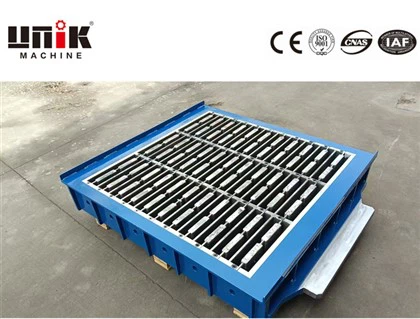
Tool Steel for Harsh Mixes: When and Why to Upgrade Your Mould Material
In concrete block manufacturing, mould performance depends on more than machining accuracy and machine settings. The steel used to manufacture a mould plays a critical role in determining its wear resistance, dimensional stability, and service life.
For manufacturers working with highly abrasive concrete mixtures, standard mould materials may wear faster than expected. Sharp sand, crushed aggregates, and recycled concrete materials can gradually erode cavity surfaces, affect block dimensions, and increase maintenance requirements.
Upgrading to tool steel can be a practical solution for these demanding conditions. However, the decision should be based on the actual characteristics of the concrete mixture, production volume, operating conditions, and total cost of ownership.
UNIK Mould provides concrete block mould solutions using different steel grades, including 42CrMo, Cr12MoV, and 9CrSi for applicable designs. Understanding the differences between these materials can help manufacturers select a mould that balances durability, production efficiency, and cost.
1. Why Do Harsh Concrete Mixes Cause Faster Mould Wear?
Concrete block moulds are repeatedly exposed to mechanical pressure, vibration, and friction during production. The aggregate particles in the concrete mixture can gradually wear the mould's contact surfaces, particularly around cavity walls, edges, and other high-contact areas.
Several factors can accelerate this process.
Sharp and Angular Aggregates
Crushed stone and angular sand particles have irregular edges that can increase abrasive contact with mould surfaces. Under repeated vibration and compaction, these particles may gradually remove material from the cavity walls.
Recycled Concrete Aggregates
Recycled aggregates can vary in particle shape, hardness, and composition. Depending on their source and processing, they may increase mould wear and make production conditions less predictable.
High Production Volume
Even when the concrete mixture is relatively consistent, high-frequency production exposes the mould to repeated cycles of abrasion and mechanical loading. Over time, cavity dimensions may change, affecting the consistency of the finished blocks.
Inadequate Material or Heat Treatment
A mould manufactured from unsuitable steel or processed with inadequate heat treatment may lose its dimensional accuracy more quickly. Insufficient surface hardness can accelerate wear, while excessive brittleness can increase the risk of cracking or chipping.
For manufacturers experiencing frequent mould replacement, the first step is to identify whether abrasive wear, mechanical fatigue, incorrect machine settings, or another issue is responsible.
2. What Is Tool Steel, and Why Is It Used for Concrete Block Moulds?
Tool steel is a category of steel developed for applications requiring specific combinations of hardness, wear resistance, strength, and toughness.
Certain tool steels are particularly suitable for concrete block moulds because their properties can be improved through appropriate heat treatment and precision machining.
UNIK Mould identifies Cr12MoV and 9CrSi among the alloy tool steels used for applicable mould designs. These grades can provide good resistance to abrasive wear when correctly processed and matched to the production environment.
The main advantages of suitable tool steel include:
Improved wear resistance: Properly heat-treated tool steel can resist gradual erosion caused by abrasive aggregates.
Dimensional stability: Suitable material properties and manufacturing processes help preserve mould cavity geometry over repeated production cycles.
Longer maintenance intervals: Better resistance to wear may reduce the frequency of mould replacement or refurbishment under comparable operating conditions.
Consistent product dimensions: Maintaining cavity geometry helps manufacturers produce blocks that meet specified dimensional requirements.
However, tool steel is not automatically the best choice for every application. Its performance depends on the exact grade, heat treatment, mould design, manufacturing quality, and operating conditions.
3. 42CrMo vs. Cr12MoV vs. 9CrSi: Which Steel Should You Choose?
Different steel grades offer different balances of toughness, hardness, and wear resistance. The most appropriate choice depends on the demands of the production line.
| Steel grade | Main characteristics | Typical application considerations |
|---|---|---|
| 42CrMo | Good strength, toughness, and resistance to mechanical loading | General-purpose moulds and demanding production with standard concrete mixes |
| Cr12MoV | High-carbon, high-chromium tool steel with strong wear-resistance potential after suitable heat treatment | Highly abrasive mixes and applications where cavity wear is a major concern |
| 9CrSi | Alloy tool steel valued for hardness and resistance to abrasive wear | Selected mould designs requiring a suitable balance of hardness and wear resistance |
These descriptions are general material-selection guidelines rather than a universal ranking. Actual performance depends on the steel's condition, heat treatment, mould geometry, and the nature of the concrete mixture.
When Is 42CrMo a Practical Choice?
For manufacturers using relatively standard concrete mixtures, 42CrMo can offer a useful balance between strength, toughness, and wear resistance.
It may be suitable for medium- to high-volume production where the mould must withstand repeated vibration and mechanical loading without becoming unnecessarily expensive.
When Should You Consider Cr12MoV?
Cr12MoV is worth evaluating when mould wear is a persistent problem, especially when the concrete mixture contains sharp sand, crushed aggregates, or recycled materials with significant abrasive characteristics.
Its high-carbon, high-chromium composition supports high hardness and wear resistance after appropriate processing.
However, the final mould design must also account for toughness and resistance to impact. A material selected solely for maximum hardness may not be suitable if it becomes too brittle for the machine's operating conditions.
When Is 9CrSi Worth Considering?
9CrSi is another tool steel used in certain mould applications where hardness and resistance to abrasive wear are important.
Its suitability depends on the mould's geometry, loading conditions, required service life, and the heat-treatment process used by the manufacturer.
The best approach is to compare the complete mould specifications rather than selecting a grade based on its name alone.
4. Why Heat Treatment Matters as Much as Steel Selection
Selecting a suitable steel grade is only part of the process. Heat treatment significantly influences how the mould performs during repeated production.
A mould needs sufficient surface hardness to resist abrasion, but it also needs adequate toughness to withstand vibration and mechanical loads.
One approach used in mould manufacturing is carburizing, a thermochemical process that increases the carbon content near the steel surface before subsequent hardening operations. When properly controlled, this can produce a hard outer layer while retaining a tougher core.
UNIK Mould describes a carburizing process for applicable mould designs that targets surface hardness of approximately HRC 58–62 and core hardness of approximately HRC 35–40.
This combination is intended to address two different requirements.
Hard surface: Helps resist abrasive wear from sand and aggregate particles.
Tougher core: Helps absorb mechanical loads and vibration, reducing the risk of brittle failure when the design and treatment are appropriate.
The actual hardness profile depends on the steel grade, component thickness, treatment parameters, and inspection method. These values should therefore be confirmed for the specific mould being purchased.
Heat treatment should also be controlled carefully to limit distortion and preserve the dimensional accuracy achieved during machining.
5. Signs That Your Mould Material May Need an Upgrade
Not every mould problem requires a more expensive steel grade. However, several warning signs may indicate that the existing material or manufacturing process is unsuitable for the production conditions.
Rapid Wear of Cavity Walls
If cavity surfaces wear noticeably after relatively short periods of operation, the steel grade, surface hardness, aggregate abrasiveness, and operating conditions should be reviewed.
Increasing Dimensional Variations
Changes in cavity dimensions can cause blocks to fall outside specified tolerances. If inspection confirms that mould wear is responsible, a more wear-resistant material or improved heat treatment may be beneficial.
Frequent Mould Replacement
Repeated replacement can increase purchasing costs, installation labour, and production downtime. Upgrading the mould material may be justified if the existing mould consistently wears too quickly.
Surface Damage or Chipping
Chipping and cracking do not necessarily indicate insufficient hardness. They may result from excessive brittleness, stress concentrations, poor machining, misalignment, or incorrect machine settings.
Before changing steel grades, investigate the failure pattern and determine whether a material upgrade, a design adjustment, or a process correction is required.
6. How to Calculate Whether a Tool Steel Upgrade Is Worth the Cost
A higher-grade mould may have a higher initial purchase price, but its value should be evaluated over the full production period.
The most useful comparison is the cost per production cycle or, where output is measurable, the tooling cost per acceptable block.
A simplified formula is:
Mould cost per cycle = Total mould cost ÷ Number of usable production cycles
For example, consider two hypothetical mould options:
| Item | Standard mould | Upgraded tool-steel mould |
|---|---|---|
| Purchase price | $1,000 | $1,500 |
| Usable production cycles | 40,000 | 80,000 |
| Mould cost per cycle | $0.025 | $0.01875 |
In this example, the upgraded mould costs 50% more initially but provides twice the usable cycles. Its mould purchase cost per cycle is 25% lower.
These figures are illustrative only, not quoted UNIK Mould prices or guaranteed service-life results. Actual results depend on the material, mould design, production conditions, maintenance, and quality requirements.
A more complete calculation should also include:
Replacement and installation labour.
Production downtime during mould changes.
Repair and refurbishment expenses.
Rejected blocks caused by dimensional wear.
Freight and procurement costs.
The cost of keeping spare moulds in stock.
If an upgrade reduces these expenses sufficiently, the higher initial price may be justified.
7. How to Select the Right Mould Material for Your Production Line
Before ordering a replacement mould or upgrading to tool steel, manufacturers should review several important factors.
Analyze the Concrete Mixture
Identify the aggregate types, particle shapes, sand characteristics, and proportion of recycled materials. If the mix changes frequently, evaluate the most abrasive production conditions rather than relying only on the average mix.
Review Production Volume
A mould used for occasional production may not require the same material specification as one operating continuously on an automated production line.
Higher production volume increases the importance of wear resistance, predictable maintenance intervals, and dimensional stability.
Check Machine Conditions
Vibration, pressing forces, alignment, and machine settings affect the loads experienced by the mould.
Excessive vibration, incorrect clearances, or misalignment can accelerate wear or cause damage regardless of the steel grade.
Confirm Heat Treatment and Inspection
Ask the manufacturer about the heat-treatment method, target surface hardness, core properties where applicable, dimensional inspection, and quality-control procedures.
Hardness measurements alone do not provide a complete assessment of mould quality. The depth of the hardened layer, material toughness, machining accuracy, and structural design must also be considered.
Request a Specification-Based Recommendation
Provide the mould manufacturer with your machine model, block dimensions, concrete mixture characteristics, production volume, and current mould failure patterns.
This information helps the supplier evaluate whether 42CrMo, Cr12MoV, 9CrSi, or another suitable material is appropriate for your application.
8. Why Consider UNIK Mould for Harsh Concrete Mixes?
UNIK Mould manufactures concrete block moulds for different production requirements and identifies 42CrMo, Cr12MoV, and 9CrSi among the materials used for applicable products.
Its material-selection approach considers the concrete mixture, expected output, and operating conditions rather than assuming that one steel grade suits every production line.
For manufacturers handling abrasive concrete mixtures, relevant considerations include:
Material selection: Matching the steel grade to the expected wear and mechanical loading.
Heat treatment: Developing suitable surface hardness while maintaining appropriate core toughness.
Precision machining: Maintaining cavity dimensions and component clearances.
Quality inspection: Checking the finished mould against the required specifications.
Customized solutions: Assessing mould requirements according to the machine and intended concrete product.
UNIK Mould's steel block mould product range provides further information about its steel mould solutions.
For highly abrasive applications, buyers should discuss their actual concrete mixture and production conditions with the manufacturer before selecting a material grade.
Conclusion
Tool steel can be a valuable upgrade for concrete block moulds when abrasive aggregates cause excessive wear, frequent replacement, or unacceptable dimensional variations.
Cr12MoV and 9CrSi are worth considering for suitable high-wear applications, while 42CrMo can provide a useful balance of strength and toughness for many general production conditions. The final decision should be based on the complete mould design, heat treatment, production requirements, and operating environment.
A successful upgrade is not simply about choosing the hardest steel. It requires the right combination of material properties, controlled heat treatment, precision machining, and proper machine operation.
For concrete block manufacturers looking to improve mould service life and reduce long-term production costs, evaluating the steel grade is an important step toward more reliable manufacturing.
To explore available mould materials and discuss your production requirements, visit the official UNIK Mould website: https://www.unikmould.com/.