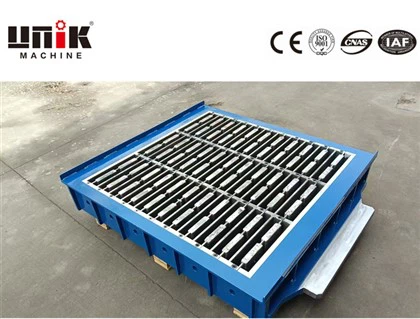
What Affects Concrete Mould Lifespan?
Concrete mould lifespan is one of the most important factors affecting the operating costs and production efficiency of a block or paver manufacturing plant. A mould that wears out too quickly can lead to frequent replacement expenses, unexpected production downtime, inconsistent product dimensions, and increased material waste.
However, mould lifespan is not determined by steel quality alone. It is influenced by several factors, including material selection, heat treatment, concrete mix composition, machine operating conditions, mould design, machining precision, and daily maintenance.
For concrete block manufacturers, understanding these factors is essential to choosing the right mould and maximizing its service life.
1. Steel Material Quality
The type and quality of steel used in a concrete mould directly affect its resistance to abrasion, impact, and deformation.
During production, concrete aggregates repeatedly contact the mould cavity. Sand, crushed stone, recycled concrete, and other hard particles gradually wear down the cavity surfaces. If the steel has insufficient hardness or toughness, the mould may develop excessive wear, cracks, or dimensional changes after relatively few production cycles.
Common materials used in concrete mould manufacturing include:
42CrMo steel: A chromium-molybdenum alloy steel that offers a good balance of strength, toughness, and wear resistance. It is suitable for many standard concrete block and paver production applications.
Cr12MoV tool steel: A high-carbon, high-chromium tool steel with excellent hardness and abrasion resistance. It is particularly suitable for demanding applications involving sharp sand, recycled aggregates, or other abrasive concrete mixtures.
Other tool steels: Depending on production requirements, specialized tool steels may be considered for moulds exposed to particularly severe wear conditions.
The correct material should be selected according to the concrete mix, production volume, machine conditions, and expected service life. Choosing the cheapest steel without evaluating its mechanical properties may result in higher long-term replacement costs.
UNIK's product information identifies 42CrMo as a standard material option and offers tool steel options such as Cr12MoV for more abrasive production conditions.
2. Heat Treatment Quality
Steel selection is only part of the equation. Heat treatment is another major factor affecting concrete mould durability.
A mould must resist continuous surface abrasion while maintaining enough internal toughness to withstand repeated vibration and mechanical impact. If the entire mould is excessively hardened, it may become brittle and more susceptible to cracking. If the surface hardness is insufficient, the cavity may wear out quickly.
Carburizing heat treatment is one method used to address this challenge. It creates a hard surface layer while retaining a tougher internal structure.
According to UNIK's technical information, its standard heat treatment specifications include:
| Parameter | Technical specification |
|---|---|
| Heat treatment | Carburizing |
| Surface hardness | HRC 58–62 |
| Core hardness | HRC 35–40 |
| Main purpose | Surface wear resistance and internal toughness |
The harder surface helps resist abrasion from concrete aggregates, while the tougher core helps absorb repeated vibration and impact during production.
Consistent heat treatment is therefore essential. Uneven hardness, insufficient hardening depth, or improper processing may cause premature wear, deformation, or fatigue cracking.
3. Concrete Mix Composition and Aggregate Abrasiveness
The concrete mixture used in production has a direct influence on mould wear.
Different aggregates have different levels of hardness, particle shapes, and abrasion characteristics. Sharp-edged sand, crushed stone, recycled concrete aggregates, and certain mineral materials can cause more aggressive wear than smoother, less abrasive materials.
Several mix-related factors deserve attention:
Aggregate hardness: Harder aggregates generally create greater abrasive contact with mould cavity surfaces.
Particle shape: Angular particles can produce more concentrated contact and scratching than rounded particles.
Aggregate size: Larger or irregular particles may increase localized contact and mechanical friction, depending on the mix and compaction process.
Mix consistency: An unsuitable or inconsistent mix can affect filling, compaction, and demoulding, potentially increasing mechanical stress on the mould.
Manufacturers should evaluate the actual raw materials used in their production lines before selecting mould steel. For standard concrete mixes, 42CrMo may provide a suitable balance of performance and cost. For highly abrasive mixtures, a higher-wear-resistance tool steel such as Cr12MoV may be more appropriate.
4. Machine Vibration and Operating Conditions
Concrete block production usually involves repeated filling, vibration, pressing, and demoulding. These operations expose moulds to continuous mechanical stress.
Excessive vibration, incorrect machine settings, poor alignment, and unstable operating conditions can accelerate mould deterioration.
For example, excessive vibration may increase fatigue stress around internal corners, mounting points, and other structural areas. Incorrect alignment between the mould and machine can also create uneven loading, causing certain cavity edges or components to wear faster than others.
To reduce unnecessary stress, manufacturers should:
Set vibration parameters according to the concrete mix and machine specifications.
Check mould alignment before production.
Ensure that mounting bolts and connecting components are properly secured.
Inspect vibration systems and pressing components regularly.
Avoid operating the machine with abnormal impact, noise, or movement.
UNIK's technical information describes a hard-surface, tough-core structure designed to balance abrasion resistance with the ability to absorb machine vibration. This balance is important for long-term mould performance.
5. Mould Design and Structural Strength
A mould's structural design also influences how long it can operate reliably.
Poorly designed internal corners, thin sections, and uneven stress distribution can create weak points. Under repeated vibration and pressing forces, these areas may develop fatigue cracks or permanent deformation.
One important design consideration is the radius of internal corners.
Sharp internal corners can concentrate stress in a small area. Adding an appropriate radius helps distribute stress more evenly and reduces the risk of fatigue cracking.
UNIK specifies 3–5 mm radii for internal corners in relevant mould designs. This design detail helps reduce stress concentration during repeated production cycles.
Other important design considerations include:
Appropriate mould plate thickness.
Sufficient structural support around cavity areas.
Proper mounting hole positions.
Accurate cavity geometry.
Compatibility with the block-making machine.
Appropriate design for the required block shape and production pressure.
A mould should be designed according to the actual machine model and production requirements rather than selected solely by external dimensions.
6. CNC Machining Accuracy and Surface Finish
Machining precision affects both product quality and mould wear.
If the cavity dimensions are inaccurate, the mould may produce blocks with inconsistent sizes or shapes. Poor surface finishing can also increase friction during demoulding, causing concrete to stick to the cavity walls and making cleaning more difficult.
High-precision CNC machining helps maintain consistent cavity dimensions and smooth surfaces.
Two important technical indicators are:
Dimensional tolerance: Accurate cavity dimensions help ensure consistent block size and reduce dimensional deviations during production.
Surface roughness: A smoother cavity surface reduces friction and helps concrete release more easily.
UNIK's published manufacturing specifications include CNC-machined cavity surfaces with a finish of Ra 1.6 or better, together with tight dimensional tolerances for relevant mould products.
These manufacturing details help reduce demoulding resistance, maintain product consistency, and limit unnecessary wear during repeated use.
7. Daily Maintenance and Cleaning
Even a high-quality steel mould can experience premature wear if maintenance is neglected.
Concrete residue left inside the cavities may gradually harden and become difficult to remove. Improper cleaning tools can scratch cavity surfaces, while insufficient lubrication of applicable moving components may increase friction and mechanical wear.
A practical maintenance routine should include:
After each production shift:
Remove residual concrete from mould cavities and contact surfaces.
Clean the mould using suitable tools.
Check for visible cracks, scratches, and abnormal wear.
Inspect mounting components and moving parts.
During regular maintenance:
Check cavity dimensions and edge conditions.
Inspect the mould's surface hardness and wear condition when necessary.
Lubricate designated components according to equipment requirements.
Record production cycles and maintenance activities.
Before long-term storage:
Clean and dry the mould thoroughly.
Apply suitable anti-rust protection to exposed steel surfaces.
Store the mould in a dry environment.
Keep it on a stable, flat support to prevent deformation.
Avoid direct contact with moisture and corrosive substances.
A documented maintenance schedule makes it easier to identify early signs of deterioration and arrange repairs before a mould failure interrupts production.
8. Storage and Environmental Conditions
Storage conditions are sometimes overlooked, but they can also affect mould lifespan.
Steel moulds exposed to moisture, rainwater, or corrosive environments may develop rust. Corrosion can damage cavity surfaces, affect dimensional accuracy, and make concrete release more difficult.
Improper stacking or placing heavy objects on a mould may also cause deformation.
To protect moulds when they are not in use, manufacturers should keep them in a clean, dry, and ventilated storage area. Protective coatings should be applied when appropriate, and moulds should be supported evenly to avoid unnecessary mechanical stress.
For factories operating in coastal regions or high-humidity environments, corrosion prevention deserves particular attention.
9. How Long Can a Concrete Mould Last?
There is no single lifespan that applies to every concrete mould. Actual service life depends on the material, heat treatment, concrete composition, production intensity, machine settings, and maintenance practices.
UNIK's published information for relevant steel mould products indicates an expected service life of approximately 80,000–100,000 production cycles under normal production conditions.
The company also provides the following operating references for certain concrete mould applications:
| Production arrangement | Approximate daily output | Reference service period |
|---|---|---|
| Single-shift operation | 1,000–1,500 blocks | 18–24 months |
| Double-shift operation | 3,000–5,000 blocks | 8–12 months |
These figures are product and operating-condition references, not guaranteed replacement intervals. Actual results may vary depending on aggregate abrasiveness, machine vibration, production frequency, and maintenance quality.
When evaluating mould lifespan, manufacturers should pay attention not only to the number of production cycles but also to whether the mould can maintain the required block dimensions and surface quality throughout its service period.
10. How to Extend Concrete Mould Lifespan
Extending mould lifespan requires a combination of correct purchasing decisions and consistent production management.
The following practices can help manufacturers reduce premature mould replacement:
Choose suitable steel: Match the steel grade to the abrasiveness of the concrete mixture and production requirements.
Check heat treatment: Verify surface hardness, core toughness, and heat treatment quality.
Select a reliable design: Pay attention to internal corner radii, plate thickness, and structural strength.
Ensure machine compatibility: Confirm mounting dimensions, cavity specifications, and operating requirements before installation.
Maintain proper machine settings: Avoid excessive vibration, abnormal impact, and uneven loading.
Clean the mould regularly: Remove concrete residue and inspect cavity surfaces after production.
Prevent corrosion: Apply appropriate protection and store moulds in dry conditions.
Monitor production cycles: Keep maintenance and inspection records to identify wear trends.
These measures help manufacturers improve mould utilization, reduce unplanned downtime, and control the total cost of concrete block production.
Conclusion
Concrete mould lifespan is influenced by multiple interconnected factors. Steel quality, heat treatment, aggregate abrasiveness, machine vibration, structural design, machining precision, and daily maintenance all play important roles.
For concrete block and paver manufacturers, choosing a mould based only on its purchase price can be a costly decision. A mould with suitable material properties, reliable heat treatment, precise cavity machining, and proper machine compatibility may provide better long-term value by reducing replacement frequency and maintaining consistent product quality.
UNIK Mould focuses on steel selection, carburizing heat treatment, CNC precision machining, and customized mould manufacturing for different concrete products and production requirements. By matching mould specifications to actual operating conditions, manufacturers can make more informed tooling decisions and improve the long-term efficiency of their production lines.